
B.Sc. Mathematics
Program Profile
The Department of Mathematics at the College of Education is an extension of the Department of Mathematics which it is was founded in 2003 at a College of Basic Education. It offers a fouryear undergraduate program leading to a Bachelor’s degree, qualifying graduates to work in governmental institutions.
Throughout their studies, students gain the essential skills and practical experience needed for their future careers.
The undergraduate curriculum is both rigorous and comprehensive, preparing students for professional and academic paths within their chosen fields. Scientific courses are designed to balance theoretical knowledge with real-world applications, making their integration highly valuable.
The department offers lectures that cover fundamental concepts and key details related to the field of specialization.
The department aims to introduce students to the stages of mathematical development.
As they advance, the curriculum becomes more specialized and in-depth, equipping them with the knowledge and expertise needed to master their field.
The academic year begins in midSeptember, following the university calendar, and ends in late June. During this period, students are required to take midterm and final examinations in all subjects.
The department also offers opportunities for interdisciplinary research and study within major fields, helping students expand their knowledge and analytical abilities.
The primary goal of the department is to prepare students to become qualified teachers.
The college equips future educators with foundational teaching principles, along with psychological and educational courses relevant to their specialization.
Recognizing the importance of strong Date approved:
mathematical skills, the Department of Mathematics trains future teachers to inspire appreciation and understanding of mathematics in their students. In addition, the department offers Master of Science in Mathematics Education (M.Sc.) the postgraduate programme emphasizing advanced mathematical topics, research methods, and curriculum development.
Occupational profiles of graduates
Graduates of the Mathematics Education programmes can pursue careers in various educational and professional settings, including:
1. Mathematics Teacher (Primary, Secondary, and High School) – Teaching mathematics using modern instructional strategies.
2. Curriculum Developer – Designing, reviewing, and improving mathematics curricula and educational materials.
3. Educational Supervisor / School Administrator – Supervising mathematics departments or contributing to school leadership.
4. Educational Researcher – Conducting studies in mathematics education, assessment, and pedagogy.
5. Instructional Designer / E-learning Specialist – Developing digital mathematics content and online learning platforms.
6. Private Tutor / Training Center Instructor – Teaching and supporting students in private educational institutions.
7. Data Analyst / Technical Assistant – Applying mathematical and statistical skills in administrative or technical roles.
8. Graduate Studies Candidate – Pursuing M.Sc. or Ph.D. degrees in mathematics or mathematics education.
Qualification awarded
The Bachelor of Mathematics
Length of programme
4 years (8 semesters)
Number of credits
240 ECTS credits
Mode of Study
Full time on campus
Read more about the programme
Get detailed information about the programme requirements, courses, credits, and educational objectives as a PDF file.
Program Educational Objectives (PEOs)
Graduates of the Mathematics Education programmes will be able to:
1. Apply strong mathematical knowledge and pedagogical skills in educational settings.
2. Demonstrate professionalism, ethical conduct, and commitment to continuous learning.
3. Utilize modern teaching strategies and technologies to enhance mathematics learning.
4. Engage in research that contributes to the development of mathematics education.
5. Serve the community and educational institutions through leadership and collaboration.
Program Learning Outcomes
Graduates of the Mathematics Education programmes will be able to:
Knowledge (K):
1. Demonstrate deep understanding of key mathematical concepts in pure and applied mathematics.
2. Explain educational theories, teaching strategies, and curriculum principles relevant to mathematics education.
Skills (S):
3. Apply mathematical reasoning, problem-solving techniques, and analytical skills effectively.
4. Use modern technologies, digital tools, and software to teach and communicate mathematical ideas.
5. Conduct research using appropriate methodologies in mathematics and mathematics education.
6. Design, implement, and evaluate lesson plans aligned with curriculum standards.
Values & Professional Responsibility (V):
7. Demonstrate professional ethics, responsibility, and effective communication in educational environments.
8. Work collaboratively in teaching, research, and community service initiatives.
9. Engage in continuous professional development and lifelong learning.
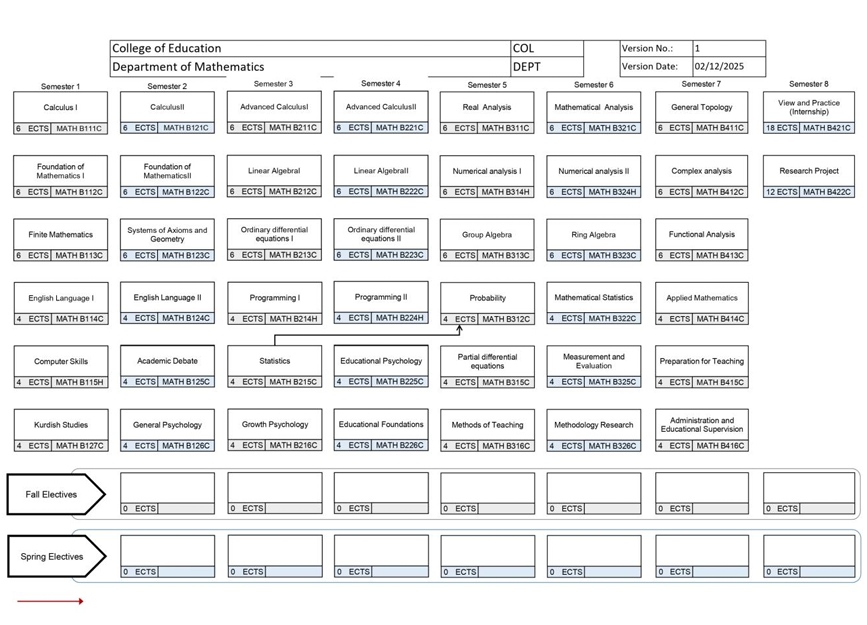
Programme structure diagram with credits
Yearly Timeline
Sept. 1, 2026
⚠️ First year students start around mid-October
⚠️ First year students start exams around 20 of January
July 1, 2027
Check out the full academic calendar on UoD's webstie.
Programme Coordinator

Lecturer in Relator Spaces
Mathematics
College of Education
University of Duhok
Apply to the Programme
Public undergraduate admissions in the KRG region are managed centrally by the Ministry of Higher Education through the online ZankoLine portal (regayzanko.com). After Grade 12 Baccalaureate results are released, high schools provide students with unique login credentials to rank their preferred universities and B.Sc. majors during a 10–14 day registration window. Final placement is automatically determined by the student's Grade 12 average, subject choices, and department capacity.