B.Sc. English Language
Program Profile
The Translation Department was established within the College of Humanities in 2011-2012. Its first and main academic programme is the Bachelor of Translation. The programme welcomed its first cohort of students in October 2010.
The programme is designed and regularly reviewed to meet the current and future needs of the Kurdistan Region and Iraq for qualified translators and interpreters.
The curriculum adheres to University of Duhok’s requirements and provides a balanced foundation across both theoretical and practical aspects of translation and interpretation. The curriculum integrates courses in linguistics, translation theory, specialized translation, and interpreting.
Practical translation and interpretation sessions further enhance students’ skills in text analysis, problem-solving, and effective communication across languages.
Additionally, the programme includes a range of core and elective courses, allowing students to tailor their education according to their interest and evolving market demands.
Occupational profiles of graduates
Graduates of this programme are equipped with strong linguistic competence, advanced translation skills, and a deep understanding of cross-cultural communication. Their training in text analysis, critical thinking, and language mediation prepares them for diverse careers in translation, interpretation, media, education, and international communication; while ensuring they can adapt to the evolving needs of multilingual workplaces and global communication industries.
Typical roles for graduates include:
1. Translator: Producing accurate and culturally appropriate translations of literary, technical, legal, scientific, journalistic, and administrative texts for institutions, companies, and publishing sectors.
2. Interpreter: Providing consecutive, at-sight, and public-service interpreting in governmental offices and international organizations.
3. Editor / Proofreader: Reviewing, editing, and refining written texts to ensure linguistic accuracy, clarity, and consistency in publishing houses, media agencies, and professional offices.
4. Researcher / Academic: Conducting research or teaching in translation studies, linguistics, and related language fields in universities and research centers.
5. Freelancer / Consultant: Offering translation, editing, interpreting, cultural mediation, or language-related consultancy services to clients, organizations, and international projects.
Qualification awarded
The Bachelor of Arts in Translation
Length of programme
4 years (8 semesters)
Number of credits
240 ECTS credits
Mode of Study
Full time on campus
Read more about the programme
Get detailed information about the programme requirements, courses, credits, and educational objectives as a PDF file.
Program Educational Objectives (PEOs)
The Bachelor of Arts in Translation program aims to develop students’ linguistic skills, professional competence, and cultural sensitivity to meet the demands of a multilingual world.
It builds a strong foundation in both source and target languages, emphasizing grammar, discourse, and communication.
The curriculum balances theoretical knowledge with practical translation and interpreting techniques across various text types, including literary, legal, scientific, and media content. Interdisciplinary learning from linguistics, literature, cultural studies, and social sciences enriches students’ understanding of language in cultural and historical contexts, with particular attention to Kurdish language and identity.
The program integrates modern translation technologies like CAT tools and machine translation post-editing to prepare students for digital workflows.
Additionally, it hones academic and professional writing skills and fosters critical thinking, ethical awareness, and cultural respect.
Overall, the program offers a comprehensive education combining linguistic precision, cultural competence, technological literacy, and ethical engagement, preparing graduates for diverse translation roles locally and globally.
Program Learning Outcomes
The Translation Program prepares graduates with a well-rounded skill set for both academic and professional translation environments.
Graduates achieve high proficiency in source and target languages, including grammar, semantics, discourse, and communicative context.
They are trained to accurately translate and interpret a wide range of general and specialized texts, applying critical analysis and translation theories effectively.
The program emphasizes both consecutive and simultaneous interpreting skills and equips students to handle domain-specific texts such as legal, scientific, literary, media, and economic materials with technical precision and cultural sensitivity.
It also incorporates modern translation technologies, including CAT tools, machine-assisted translation, and post-editing, ensuring graduates can work efficiently with current industry standards. Strong academic communication skills, cultural and sociopolitical awareness—especially relating to Kurdish issues—and basic research and ethical academic writing are integral to the curriculum.
Overall, the program balances linguistic expertise, practical skills, technological proficiency, and cultural engagement to prepare students for successful translation and interpreting careers.
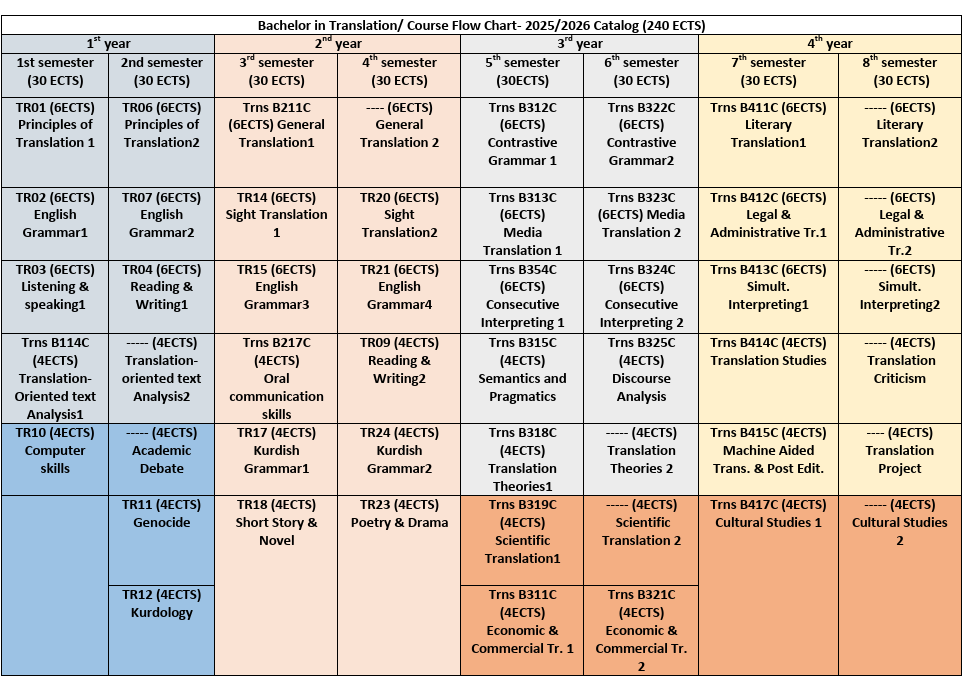
Programme structure diagram with credits
Yearly Timeline
Sept. 1, 2026
⚠️ First year students start around mid-October
⚠️ First year students start exams around 20 of January
July 1, 2027
Check out the full academic calendar on UoD's webstie.
Programme Coordinator

Apply to the Programme
Public undergraduate admissions in the KRG region are managed centrally by the Ministry of Higher Education through the online ZankoLine portal (regayzanko.com). After Grade 12 Baccalaureate results are released, high schools provide students with unique login credentials to rank their preferred universities and B.Sc. majors during a 10–14 day registration window. Final placement is automatically determined by the student's Grade 12 average, subject choices, and department capacity.